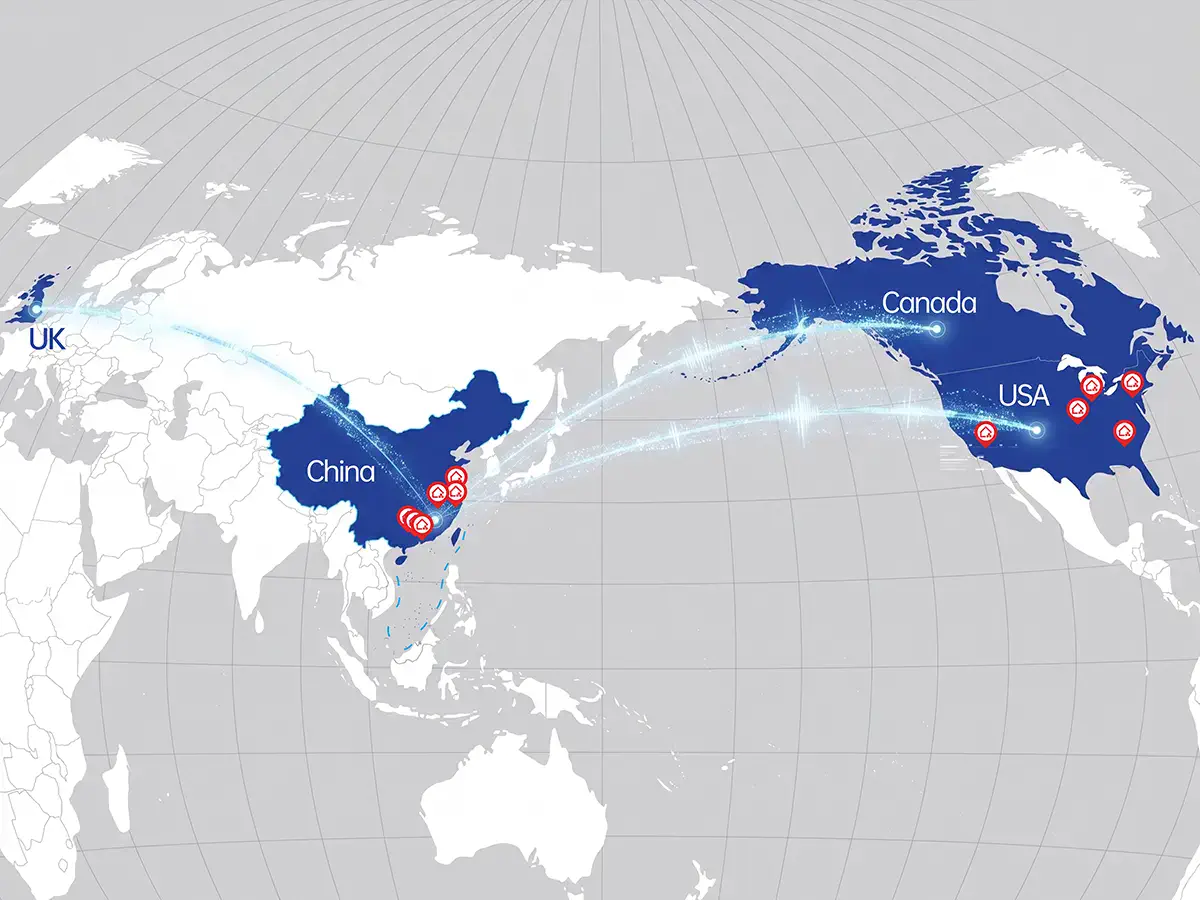
This guide is for UK businesses importing from China — B2B distributors, retailers, OEM buyers, and DTC brands. The decisions you make at quotation stage — particularly who is named as Importer of Record and whether VAT flows through your own registration — determine whether you recover the 20% Import VAT, whether you’re exposed to HMRC fronting risk, and how your supply chain reads under audit. We cover the £135 threshold, PVA, DDP channel choice, UKCA and commodity-code compliance, and how to read a freight quote line by line.
TL;DR — Shipping from China to the UK at a Glance
Pick the freight mode by volume and urgency (full breakdown in Methods Compared below):
| Mode | Best when | Door-to-door |
|---|---|---|
| FCL | ≥ 15 CBM, predictable cadence | 38–45 days |
| LCL | 1–15 CBM, sub-container loads | 38–46 days |
| Air | Freight cost < 5–8% of value, or stock-out cost dominates | 8–14 days |
| Express | Samples, urgent top-ups, ≤ 500 kg | 5–9 days |
UK economics are driven by VAT, duty, and who is named on the customs entry:
- Above £135: import VAT, usually 20%, plus duty; VAT can be paid at the border or deferred through Postponed VAT Accounting (PVA).
- At or below £135: VAT is usually charged by the seller at point of sale under UK marketplace rules.
- For VAT-registered importers, PVA keeps the 20% import VAT off the border and on the next VAT return.
| Channel | Importer of Record | VAT / duty paid via | Customer receives C79 / PVA? | When to use |
|---|---|---|---|---|
| Customer-VAT DDP (internal: K01) | Customer (your GB EORI) | Customer’s own UK VAT | ✅ Yes | Default for any VAT-registered UK importer |
| Forwarder-VAT DDP (internal: K02) | UK clearance partner (their legal entity) | UK partner’s own VAT | ❌ No | For non-VAT-registered buyers; trade-off = no input VAT recovery |
Decision shortcut: if you have a UK VAT number and resell the goods, K01 is usually cheaper net of VAT recovery — import VAT comes back under K01, stays sunk under K02.
Shipping Cost from China to the UK
Most guides headline a “door-to-door DDP” all-in price — but on the same lane that number swings 30–60% on commodity, HS code, declared value, UK postcode, and VAT-registration variables. A clean DDP “range” either ends up too wide to be useful or misleadingly narrow. So we publish what is actually stable and verifiable — the port-to-port freight leg — and we disclose every component stacked on top of it.
Freight-leg market reference only (May 2026 sample)
| Mode | Rate (May 2026) | Transit |
|---|---|---|
| FCL 20′ — Southampton | £1,075–£1,315 | 25–28 days port-to-port |
| FCL 40′ / 40′ HC — Southampton | £1,680–£2,055 | 25–28 days port-to-port |
| LCL — Southampton | £40–£120 / CBM | 26–32 days |
| Air freight — LHR / MAN / BHX | £4.50–5.50 / kg | 5–8 days airport-to-airport |
| Express courier (≤ 200 kg) | £8.00–9.50 / kg | 5–9 days door-to-door |
Source / use: market reference from May 2026 industry rate snapshots for the Southampton lane (BoE GBP/USD ≈ 1.34, sampled 18–22 May 2026; refresh quarterly). Directional freight-leg benchmarks only, not contract quotes — actual rates depend on origin port, carrier slot, commodity, HS code, season, surcharges, postcode, and IOR setup. Q3 peak and Red Sea routing can shift prices within weeks.
What sits on top of the freight leg (the DDP build-up)
The freight leg is only one part of the door-to-door DDP bill. Depending on commodity, declared value, duty rate, VAT treatment, and UK postcode, the rest can be just as important:
- Origin haulage + export clearance — £100–£250 (factory to China port + export documentation)
- UK customs declaration + entry fees — £100–£300 (single declaration; multi-HS shipments cost more)
- Duty — by HS code: 0–12% typical on consumer goods; 4–12% on textiles; higher on anti-dumping HS lines. The right commodity code is worth thousands — always verify the live rate before signing.
- Import VAT — 20% on (CIF + duty). On a £30,000 shipment that’s £6,000 — larger than the freight bill on a 20′.
- Last-mile UK delivery — £80–£600 depending on postcode region and pallet count (Felixstowe → Birmingham vs Inverness sits at opposite ends). Ask explicitly what’s bundled.
- Demurrage / detention — £80–£250+/day at Felixstowe if your warehouse can’t accept the container within free time (typically 3–7 days).

Not sure whether K01 or K02 fits your shipment?
Tell us whether you have a UK VAT number and GB EORI, plus your shipment value and UK delivery postcode. We’ll explain which channel keeps the VAT trail clean before you book.
Methods Compared: Ocean Freight, Air, Express
1. Ocean Freight (FCL / LCL) — for most commercial shipments
Ocean freight is the default option for China → UK inventory moves because it gives the lowest freight cost per unit once timing is flexible. Use FCL when you have roughly 15+ CBM or predictable monthly volume; a 20′ container fits about 26–28 CBM of palletised mixed cargo, while a 40′ / 40′ HC fits about 56–68 CBM. Use LCL for 1–15 CBM when you do not have enough cargo to fill a container, but still want sea-freight economics.
Transit: FCL usually takes 28–35 days port-to-port from Shenzhen / Ningbo / Shanghai to Felixstowe or Southampton, and 38–45 days door-to-door under DDP. LCL is usually 35–45 days door-to-door because the shipment needs origin consolidation and UK CFS de-consolidation before final-mile delivery.
Cost pattern: FCL per container, LCL per CBM. Door-to-door DDP layers origin charges, UK clearance fees, duty, 20% VAT, and last-mile on top.
Best for: FCL suits B2B distributors, retail replenishment, OEM buyers, and repeat importers with stable volume. LCL suits first-time importers, DTC brands, and slower-moving SKUs below the 15-CBM threshold.
Watch out for: FCL carries demurrage / detention risk if your warehouse cannot receive the container within free time; LCL carries more handling risk because cargo is consolidated with other shippers’ goods. For fragile goods, palletise and corner-protect the shipment either way.
2. Air Freight — for high-value, time-sensitive, or low-volume goods
Air freight from China to UK airports (Heathrow, Manchester, Birmingham) runs around £4.50–5.50 per kg for general cargo, spiking in Q4 ahead of Christmas. Transit: 6–10 days airport-to-airport; 8–14 days door-to-door including UK customs clearance and final-mile.
Best for: products where freight cost stays under 5–8% of declared value (electronics, fashion, supplements), urgent replenishment, sample shipments, or any time air-freight cost is dwarfed by stock-out cost.
Watch out for: dimensional / volumetric weight billed if higher than actual weight; lithium-battery and dangerous-goods surcharges; quota-driven rate volatility in Q4.
3. Express Courier (DHL / FedEx / UPS / DPD)
Express courier runs at roughly £8–9.50 per kg for shipments ≤ 200 kg, with door-to-door transit of 5–9 days. UK final-mile typically lands via DPD — broadest UK parcel coverage, our default for B2B distribution and DTC ecommerce replenishment.
Best for: parcel-scale shipments under 500 kg, samples, urgent stock top-ups, e-commerce fulfilment.
Watch out for: customs declaration accuracy — express carriers hold parcels at HMRC until duty / VAT is settled, which can add 2–5 days if commodity codes or invoice values are queried. For B2B importers planning ongoing flows, DDP express via your own GB EORI keeps the C79 paper trail intact; “all-in” express prepay can leave you without VAT recovery. Carrier allocation can vary by postcode, parcel profile, and service level.
Transit Times: China → UK Door-to-Door
Industry transit-time answers (“30 days,” “45 days,” “depends”) rarely break out where the days actually go. We give two figures per mode: a market-typical range (⚪️, what the industry publishes) and our channel actuals where we have current operational data (✅).
Mode-by-mode breakdown (May 2026 sample)
| Mode | Market reference ⚪️ | Our channel ✅ | What sits inside |
|---|---|---|---|
| FCL sea-DDP | 35–45 days door-to-door | Our DDP lanes: 38–45 days | 2–4 days origin haulage + 25–28 days port-to-port + 5–7 days UK customs + 3–6 days last-mile (DPD) |
| Sea consol (LCL / 海卡) | 40–50 days door-to-door | Our LCL lanes: 38–46 days | 4–7 days origin consolidation + 26–32 days port-to-port + 5–7 days UK CFS de-consol + 3–6 days last-mile |
| Air freight | 8–14 days door-to-door | ⚪️ market reference | 1–2 days origin pickup + 5–8 days airport-to-airport + 2–4 days UK customs + 1–2 days last-mile |
| Express courier | 5–9 days door-to-door | ⚪️ market reference (DHL / FedEx / UPS / DPD lane-specific) | same-day origin + 3–5 days carrier transit + 1–2 days UK customs + 1–2 days last-mile |
Why the channel actuals matter: a “45 days door-to-door” headline can mean 38 days of pure sea + 7 days of UK clearance bottleneck, or 25 days of sea + 20 days of UK customs hold on an HS-code query. Knowing where the time actually sits tells you what to optimise — better forecasting (sea leg is fixed) vs better paperwork (clearance leg is yours to influence).
Variables that move transit by 5–10 days
- Q3 peak season (Aug–Oct) — capacity squeezes push FCL transit out by 5–10 days; book 3–4 weeks ahead
- Chinese New Year holiday — 2–3 weeks of zero origin departures; plan inventory cover from late December
- Red Sea / Suez routing diversions — Cape of Good Hope re-routing adds 7–10 days to Asia–EU sea legs; still in effect through most of 2026
- HS code or commodity-code queries at UK customs — adds 2–7 days if HMRC requests further documentation
Source: ✅ channel actuals are May 2026 ops data on our UK DDP and LCL lanes. ⚪️ market references cross-checked against Freightos FBX, Drewry WCI, and industry monthly rate snapshots, May 2026. Refresh quarterly.
How DDP Works in UK Imports
DDP is the only Incoterm where the seller clears UK customs and pays UK duty + import VAT (framework: Incoterms Explained for Importing from China: EXW, FOB, CIF, DAP & DDP; broader DDP mechanics: DDP Shipping from China). This page focuses on UK-specific mechanics.
What’s inside a UK DDP shipment
A complete UK DDP delivery covers six legs. The first three — origin haulage from factory to China port/airport, Chinese export clearance, and the international freight leg — are generic to any DDP lane and covered in our DDP pillar above. UK-specific work begins at leg 4:
- UK import clearance — HMRC entry filed under a UK GB EORI, duty and import VAT paid
- Last-mile UK delivery — port / airport to your warehouse postcode
- Document handover — customs declaration copy + (where applicable) C79 / PVA statement + commercial invoice + packing list
DDP does not cover unloading beyond kerb-side delivery.
Who is the Importer of Record?
The Importer of Record (IOR) is the legally-named entity on the UK customs declaration — the party HMRC holds responsible for duty, import VAT, commodity-code accuracy, and any post-clearance audit. UK customs declarations require a GB EORI number for the named importer, and that GB EORI ties directly to a registered legal entity.
In our operating model, we support two compliant structures (internally labelled K01 and K02 — not official HMRC terms):
Customer-VAT DDP (default for VAT-registered UK importers)
Your GB EORI is named as the importer on the customs declaration. Our UK clearance agent files the entry on your behalf — paying duty and import VAT against your VAT account. Your VAT return shows the import via Postponed VAT Accounting (PVA) or via the monthly C79 statement, both issued by HMRC’s Customs Declaration Service against your VAT number. The 20% import VAT is recoverable — typically in the same VAT return period it’s paid in.
Forwarder-VAT DDP (for non-VAT-registered buyers)
Duty and import VAT are filed by our UK clearance partner under their own VAT registration. This is a compliant arrangement — the UK partner is the legally-named importer and reports the import on their own VAT account — but as a trade-off, the import VAT documentation (C79 / PVA) is generated against the UK partner’s VAT number, not yours. You don’t recover the 20% import VAT as input tax, because you weren’t the importing party of record on the declaration. We offer K02 on request, with the VAT-recovery trade-off disclosed up front.
The fronting red flag (what HMRC actually penalises)
There is a third “channel” you’ll see quoted in the market — and we will not offer it: an unrelated UK VAT number being “lent” to file the customs entry, with neither the customer nor the named entity being the actual importing party. HMRC calls this VAT fronting or abuse of registration, and it triggers retrospective duty recovery, VAT assessment, and (for the lending entity) loss of registration. A 20′ FCL DDP quote substantially below market freight cost — especially with no transparency on whose GB EORI is named — is the classic red flag. Always ask: “Whose GB EORI is named on the customs declaration, and whose VAT account does the import VAT post to?” Both answers should match either your own (K01) or our named UK partner’s (K02). If neither, walk away.
How to Read a UK DDP Quote
A UK DDP quote should sit on four cost categories, all visible to you as line items, with no opaque “miscellaneous fees” buried in the total. If your quote shows a single all-in number with no breakdown, ask for itemisation — every legitimate forwarder can produce it, and a refusal usually signals embedded margin.
The four categories every UK DDP quote should show
Category 1 — Origin charges (China side)
Pickup haulage from factory to port / airport · export customs declaration · origin terminal handling (THC) · origin documentation. Typically £100–£250 for FCL, similar for LCL on a per-CBM basis, £30–£80 for express / air pickup.
Category 2 — International freight (main leg)
The sea / air / express rate itself — the verifiable port-to-port or airport-to-airport number that anchors the quote. This is the one category where the industry can publish market-reference ranges; the other three depend on commodity, postcode, and VAT registration.
Category 3 — Destination charges (UK side)
UK import customs declaration (filed under your GB EORI for K01, or under our UK partner’s for K02) · destination terminal handling (DTH) at Felixstowe / Southampton · duty (commodity-code dependent; verify the live rate before signing) · import VAT 20% on (CIF + duty) — usually the largest single number in the quote. Cargo insurance is usually quoted separately (typically 0.2–0.5% of CIF) and is not part of a standard DDP quote — request it explicitly if you want freight covered.
Category 4 — Last-mile UK delivery
Port / airport to your final postcode. Typically £80–£600 depending on postcode region (central belt vs Highlands & Islands), pallet count, and whether delivery requires tail-lift or two-person handling.
Our quote discipline — no opaque “misc fee”
Every UK DDP quote we issue is built on the four categories above and contains no “miscellaneous” line. Once the quote is signed off, the only charges that can change post-shipment are:
- Demurrage / detention — if your warehouse can’t accept within the agreed free-time window (typically 3–7 days at Felixstowe)
- HMRC reassessment — if HMRC challenges the declared HS code or value post-clearance (rare; we file under documented BTI rulings where available)
- Force-majeure surcharges — Red Sea routing diversion, fuel surcharge revisions announced by the carrier mid-transit
All three are disclosed in advance with cause + responsible party.
Red flags to check before signing
- Hidden import VAT — quote shows a low “all-in” number but doesn’t separately line-item the 20% import VAT; either the VAT isn’t being paid (fronting) or it’s being absorbed (you can’t recover what isn’t documented to you)
- No GB EORI named — every legitimate UK DDP quote should specify on whose GB EORI the entry is filed (yours / K01 or our partner’s / K02)
- Unusually high outside Q3 peak — 20′ FCL DDP above ~£12,000 outside Aug–Oct usually hides textile duty, anti-dumping, or embedded margin; request line-item breakdown
- Unusually low below freight leg — 20′ FCL DDP below ~£900–£1,000 sits under bare port-to-port cost; either VAT isn’t being paid through or someone else’s registration is filing the entry
Need a line-item UK DDP quote?
Send us your origin city, CBM or weight, HS code, declared value, UK postcode, and VAT / EORI status. We’ll return a China-to-UK DDP quote showing freight, duty, import VAT treatment, last-mile delivery, and K01 / K02 trade-offs.
VAT, Duty & the £135 Threshold
Of every cost in a UK DDP shipment, VAT and duty are the two that move most — and they’re the two that determine whether your supply chain is cash-flow neutral or carrying a 20% drag.
How UK import VAT works
UK standard VAT is 20%, charged on the customs value of imported goods plus duty (CIF + duty) — on commercial shipments, often more than the freight bill itself.
- B2B imports: VAT-registered importers owe import VAT regardless of consignment value; reclaim via PVA or C79
- B2C imports ≤ £135: seller charges VAT at point of sale (UK marketplace rules introduced 2021); no VAT at the border
- B2C imports > £135: VAT charged at the border, or via PVA if the importer is VAT-registered
- £39 gift relief: non-commercial private-to-private parcels are exempt
The £135 threshold sunset (Autumn Budget 2025)
A change to plan for: at the Autumn Budget on 26 November 2025, HM Treasury announced the scheduled withdrawal of the £135 customs duty exemption by March 2029. A public consultation ran from November 2025 to March 2026 on the design of the new arrangements. For any business currently flowing low-value B2C parcels under £135, the 2027–2029 window is when the legal landscape changes — pricing, marketplaces, and customs platforms will all need to absorb the new rules.
Postponed VAT Accounting (PVA) — the cash-flow tool
For VAT-registered importers, PVA is the single largest cash-flow lever in UK importing:
- Import VAT is declared and recovered on the same VAT return (reverse-charge mechanism)
- No cash payment at the border, no waiting for refund
- Available to any importer whose GB EORI is named on the customs declaration — i.e. the K01 channel in our DDP setup
- Monthly Postponed Import VAT Statement available via the Customs Declaration Service (CDS) by the 10th working day of the following month; retained 6 months then archived
Duty rates — UK Global Tariff and anti-dumping
The UK Global Tariff (UKGT) has been in force since 1 January 2021, replacing the EU’s Common External Tariff. A meaningful share of goods enter at zero or preferential rates under the UKGT, but rates vary by chapter: consumer goods typically sit at 0–12%, textiles at 4–12% (cotton apparel MFN 12%), leather at 3–8%.
Anti-dumping duties are the variable that turns “0–12%” into something much larger. Current China-origin examples (verified May 2026):
- Tin mill products from China: 27.85–49.98% (UK Trade Remedies Authority anti-dumping measure; verify current Notice number and expiry on the Trade Tariff before quoting)
- Folding e-bikes from China: anti-dumping in force; 5-year extension from 19 January 2024 (Trade Remedies Notice 2025/3)
- Non-folding e-bikes from China: anti-dumping lifted on 6 February 2025 (Trade Remedies Authority decision; these account for ~95% of the UK e-bike market)
- Bicycles (non-electric) from China: anti-dumping in force; most recent update 20 March 2025 (Tariff Stop Press Notice)
The duty landscape moves quarterly. Always verify the live rate for your HS code on HMRC’s Trade Tariff lookup before signing a DDP quote. For borderline classifications, apply for a Binding Tariff Information (BTI) ruling — free, valid 3 years, and pre-empts post-clearance disputes.
Sources: HMRC Trade Tariff lookup (trade-tariff.service.gov.uk/find_commodity); HM Treasury LVI consultation (Nov 2025); UK Trade Remedies Authority Notice 2026/11 (tin mill) and Notice 2025/3 (folding e-bikes); HMRC Tariff Stop Press 20 March 2025; HMRC Customs Declaration Service guidance.
Why B2B Importers Need C79 / PVA
If you’re VAT-registered and importing for resale, the difference between recovering and not recovering the 20% import VAT comes down to whether you have either of two HMRC documents.
PVA statement vs C79 certificate
- PVA (Postponed Import VAT Statement) — monthly statement via CDS listing all imports where VAT was postponed rather than paid at the border. Use this to fill Box 1 (output VAT) and Box 4 (input VAT) on your VAT return; net cash-flow impact is zero.
- C79 (Import VAT Certificate) — monthly statement via CDS listing all imports where VAT was paid at the border. Use this as evidence to claim input VAT on your next return.
Both are evidence-of-VAT-paid documents under your VAT registration. Without one, your accountant cannot defend the input VAT claim if HMRC challenges it.
What this means for VAT recovery
The C79 or PVA statement is generated against whichever VAT registration is named on the customs declaration. If yours is the named registration, the monthly statement comes back to your account and the 20% import VAT is fully recoverable as input tax on your next VAT return. If a UK clearance partner’s VAT is the named registration instead, the statement posts to their account, and you have no HMRC document under your own VAT number to defend an input-tax claim — the 20% becomes a sunk cost.
For VAT-registered UK distributors, retailers, OEM buyers, and B2B DTC brands, the practical rule is simple: if you need VAT recovery, make sure your own GB EORI / VAT registration is named on the entry. Non-VAT-registered buyers cannot reclaim the 20% either way, so the choice becomes a freight-and-service decision rather than a VAT-recovery decision.
Practical mechanics
- Subscribe to the Customs Declaration Service (CDS) — same login flow as VAT online
- Statements available from the 10th working day of the following month
- Statements are archived after 6 months — download and retain monthly as a standing accounting task
- CDS replaced the legacy CHIEF system on 30 March 2024; all current declarations flow through CDS
- Duty deferment account vs CDS cash account: VAT-registered importers running steady volume can also apply for a duty deferment account (DDA) to defer duty payment by ~30 days. PVA covers VAT, DDA covers duty — they’re complementary, not alternatives.
Sources: HMRC Postponed Import VAT Statement guidance; HMRC Import VAT Certificate (C79) guidance; HMRC Customs Declaration Service subscription guide (gov.uk/guidance/get-access-to-the-customs-declaration-service).
UK Compliance: UKCA, CE, REACH & Commodity Codes
Importing into the UK isn’t only a customs question. Product compliance — labelling, marking, chemical disclosure, safety testing — is the importer’s legal responsibility under any Incoterm, including DDP. We deliver the goods; you remain on the hook for what’s in them.
UKCA vs CE marking — the 2026 reality
Most consumer goods placed on the Great Britain market need a conformity mark. The post-Brexit landscape has finally settled into a default rule plus a small set of sector exceptions.
Default rule (most consumer goods on the GB market):
- CE marking is accepted indefinitely for in-scope categories — toys, electronics, machinery, PPE. Confirmed in the UK government’s August 2023 announcement and reaffirmed in a September 2024 ministerial statement.
- UKCA marking is voluntary for those categories — a UK alternative, not a mandate.
- Northern Ireland continues to require CE marking under the Windsor Framework.
Sector exceptions (CE recognition does not apply indefinitely):
- Medical devices — CE-marked devices already placed on the UK market remain valid until 30 June 2028; the MHRA UKCA framework continues to evolve.
- In-vitro diagnostics — separate MHRA timeline; check current MHRA guidance before importing.
- Construction products — under government review; if the position changes, a 2-year transition has been pre-committed.
For non-EU manufacturers, the practical answer in 2026: if your product carries a valid CE mark with a current EU declaration of conformity, it’s accepted on the GB market without additional UKCA conformity assessment — unless it falls in one of the sector exceptions above.
REACH (chemicals)
UK REACH applies to chemicals placed on the GB market — separate from EU REACH since Brexit. Substance registration with the Health and Safety Executive (HSE) is required for any importer placing ≥ 1 tonne/year of a substance, or articles containing substances of very high concern above threshold quantities.
Commodity codes — where audit risk lives
- Every UK customs entry requires a 10-digit commodity code
- Wrong code = wrong duty + retrospective HMRC reassessment (penalties up to 100% in fraud-grade cases)
- For borderline goods (kits, combination products, modified items), apply for a Binding Tariff Information (BTI) ruling — free, valid 3 years, locks the classification
Sector-specific labelling to budget time for
- Lithium-battery shipments — UN 38.3 test report, IATA DGR labelling for air, MSDS in English
- Food — FSA rules; allergen and nutritional declaration in English on UK-facing label
- Textiles — fibre composition in English, care symbols, country of origin
- Toys — BS EN 71 safety series testing; age grading
- Electrical — BS standards, UK plug (BS 1363 13A), 230V / 50Hz mains compatibility
What DDP does not cover
DDP moves goods through HMRC clearance to your door. It does not cover compliance certification (UKCA / CE / REACH), post-import recalls, or trademark / IP claims — the importer carries that liability. Lock commodity codes and conformity assessment before the first shipment, not after HMRC opens a query.
Sources: DBT / OPSS guidance on placing UKCA or CE Marked Products on the GB market; UK Government announcements 1 August 2023 and September 2024 (indefinite CE recognition); Product Regulation and Metrology Bill (Royal Assent 2025); HSE UK REACH guidance.
UK Ports: Felixstowe, Southampton & Demurrage Risk
UK container imports from Asia route primarily through three deep-sea hubs on the Channel coast:
- Felixstowe — UK’s largest container port (Suffolk; main deep-sea routings from Shenzhen / Ningbo / Shanghai)
- Southampton — second deep-sea hub on the south coast; DP World terminal
- London Gateway — DP World terminal at Thurrock; growing share of Asia direct calls
You don’t generally choose the port — your shipping line’s UK rotation does — but the port your container lands at affects last-mile cost and demurrage exposure.
2026 port-fee changes to note
- Felixstowe Green Energy Transfer Levy (GET): £16.66 per import full container, effective 1 April 2025 (Port of Felixstowe published rates; 2026 schedule revised ~3.8% in line with the port’s annual tariff update)
- Southampton ISPS fee: £27.96 per import laden container, effective 1 January 2026 (up from £23.16)
These are line items your forwarder should pass through transparently — they’re public, posted on the port-authority websites.
Demurrage and detention risk
Free time at most UK terminals is 5–7 days demurrage (container at the terminal) and 4–7 days detention (container at your premises). After free time, charges typically run £80–£250+ per container per day, with tiered escalation after the first week.
The cheapest mitigation is forecast discipline: book your warehouse receiving slot before the vessel arrives so HMRC clearance time doesn’t eat into the free-time window.
Sources: Port of Felixstowe Rates and Charges, 1 April 2025 (v1.4); DP World Southampton 2026 tariff advisory (effective 1 January 2026).
FBA UK: A Brief Note
Fulfilment by Amazon UK (FBA) is a channel we ship into, but not our core lane — see our broader [how to ship from China to Amazon FBA][TODO-FBA-URL] framework for carton, label, and prep fundamentals. UK FBA’s ASIN limits, fee structure, and PAN-EU exposure add operational layers beyond freight and clearance; sellers with steady FBA UK volume are usually better served by a dedicated FBA-specialist 3PL.
What we can do for FBA UK sellers:
- DDP freight to UK port / airport with K01 customer-VAT channel — your GB EORI stays named, PVA recovery intact
- Hand-off to your FBA prep partner for label / poly / case-pack work
- Direct-to-FBA inbound when shipment meets Amazon’s appointment and carton specs
For ASIN-level fee modelling or replenishment cadence advice, ask an FBA specialist — we’ll tell you upfront if we’re not the right fit.
Our UK Channels & Coverage
Our UK delivery stack runs on four internal channels with DPD as default last-mile carrier, routed through five Midlands 3PL partner warehouses (postcode areas LU / B / LE / CV / WR / WS / ST). Final carrier and warehouse hand-off are confirmed per shipment at quote stage.
| Channel | Mode | Door-to-door | Importer of Record | Best for |
|---|---|---|---|---|
| K01 | FCL sea-DDP (customer-VAT) | 38–45 days | Customer GB EORI | VAT-registered importers ≥ 15 CBM |
| K02 | FCL sea-DDP (forwarder-VAT) | 38–45 days | UK partner’s VAT entity | Non-VAT-registered buyers ≥ 15 CBM |
| B02 | Sea consolidation (LCL, 1–15 CBM) | 38–46 days | Customer GB EORI or partner VAT | Sub-container loads |
| B06 | Sea consol + palletised last-mile | 38–46 days | Customer GB EORI or partner VAT | LCL with multi-drop UK pallet delivery |
What channel anchoring buys you:
- Default DPD last-mile where applicable — UK delivery from the warehouse, postcode-level tracking, and delivery-window visibility where the service supports it
- Five Midlands partner warehouses — buffer / cross-dock / pick-and-pack capability across the M1 / M6 / M42 belt; confirmed per shipment rather than assumed as a blanket inclusion
- Single point of accountability — one document trail and one operations contact from China factory pickup through UK postcode delivery
- Pallet standardisation — UK 1200×1000 mm standard pallets across the Midlands warehouse network; Euro 1200×800 pallets accepted on request. Specify pallet type at quote stage if your UK warehouse has dock constraints.
Who We Ship For
Our UK customers cluster into four practical archetypes:
1. UK B2B distributors & wholesalers — Multi-SKU monthly / quarterly replenishment, 15–60 CBM per shipment. Need K01 + PVA recovery, BTI rulings on file, demurrage-aware receiving.
2. UK retail & retail-chain replenishment — Single-brand seasonal buys, FCL or multi-FCL volume. Need predictable transit, label / merchandise compliance, Q3 surcharge absorption into wholesale margin.
3. UK OEM buyers (component / sub-assembly) — Components into UK manufacturing or assembly lines; sub-assemblies often sit on different duty rates than finished goods, so BTI rulings matter.
4. UK DTC ecommerce brands (own-fulfilment, not FBA) — Own UK warehouse + B2C dispatch; mix of sea-DDP for stock buys and air / express for urgent top-ups. Need a clean C79 / PVA trail.
Common product categories we move on these channels: consumer electronics, fashion & apparel, home & garden, sporting goods. Within these we have repeat-shipment history; outside these (medical, food, hazmat, alcohol) we’d refer you to a specialist.
Industry pattern to know about — HMRC has been actively investigating an “abuse of registration” pattern where a freight forwarder files the UK customs entry using a VAT number that belongs to neither the buyer nor any legitimately involved entity. Cases reported across industry trade press follow a recurring shape: a “DDP all-in” quote priced well below market freight, with the customs entry filed under a third-party VAT registration. When the lending entity later loses its VAT registration, HMRC reassesses the import VAT against the named importer (or the buyer) retrospectively, with penalties. The 20% already paid into the freight price is not recoverable. Pattern description only — see HMRC guidance on customs-agent due diligence for the official position.
Before You Request a Quote — UK Checklist
The cleanest quote we can issue is one where you’ve already answered eight questions for yourself. Three minutes here saves a 90-minute back-and-forth on the quote thread.
- Volume & frequency — CBM or weight per shipment + monthly / quarterly cadence (drives FCL vs LCL vs air decision)
- Origin port / city — Shenzhen / Ningbo / Shanghai / Qingdao / inland pickup location
- HS / commodity codes — your best guess to 6-digit at minimum; for borderline goods, mention whether you have a BTI ruling
- Declared value & currency — CIF or FOB basis; tells us VAT and duty exposure immediately
- UK VAT registration status — registered (K01 + PVA recovery) or not (K02, no recovery)
- GB EORI number — yours if you have one; if not, whether you want to register (free, ~3 working days via HMRC’s EORI registration service) or run K02
- UK delivery postcode + warehouse access — pallet count, tail-lift requirement, two-person delivery, receiving hours, free-time tolerance for container detention
- Compliance status — UKCA / CE marks in place, REACH-relevant substances, lithium-battery content, sector-specific certifications (toys / electricals / food)
One question we’ll always ask back: whose GB EORI do you want named as the importer of record? That single answer decides whether the £6,000 of import VAT on a £30,000 shipment comes back to you or stays sunk.
FAQ
What’s the cheapest way to ship from China to the UK?
Sea freight, almost always. For volumes ≥ 15 CBM, FCL is cheapest per cubic metre; under 15 CBM, LCL. Air freight wins only when freight cost stays under 5–8% of declared value, or when stock-out cost dominates.
How long does shipping from China to the UK take?
Door-to-door under DDP: FCL 38–45 days, LCL 38–46 days, air 8–14 days, express 5–9 days. The freight leg is fixed by mode; the swing days sit in UK customs clearance, usually 5–7 days but longer if HS code is queried, and last-mile delivery.
Do I need a UK company or VAT registration to import from China?
No to a UK company — you can import as a non-UK entity using a UK clearance partner through K02. For VAT recovery, however, you need a UK VAT registration so you can be the named importer with your own GB EORI under K01. Without VAT registration, the 20% import VAT is a sunk cost.
What’s the difference between GB and XI EORI?
GB EORI is for Great Britain customs: England, Scotland and Wales. XI EORI is for Northern Ireland and is required if your goods cross the Irish Sea into NI, where the Windsor Framework applies. Most importers selling into GB only need a GB EORI; if you have an NI operation or move goods between GB and NI, register for XI as well.
How do I recover the 20% import VAT?
Be the named importer, with your GB EORI on the customs declaration under K01, then either claim via the monthly C79 certificate or use Postponed VAT Accounting (PVA) to declare and recover on the same VAT return. Both statements come from the Customs Declaration Service (CDS) by the 10th working day of the following month — download and retain them monthly.
What’s the £135 threshold and is it changing?
Imports above £135 commercial value are subject to import VAT and duty at the UK border. Imports at or below £135 have VAT charged by the seller at point of sale under UK marketplace rules from 2021. At the Autumn Budget on 26 November 2025, HM Treasury announced the scheduled withdrawal of the £135 customs duty exemption by March 2029; a public consultation ran from November 2025 to March 2026 on the replacement design.
Can you ship into FBA UK warehouses?
Yes — DDP freight to a UK port or airport on our K01 customer-VAT channel, with hand-off to your FBA prep partner for label and case-pack work, or direct-to-FBA inbound when carton specs allow. FBA UK is not our core scale lane, though; for steady high-volume replenishment or ASIN-level fee modelling, an FBA-specialist 3PL with prep, label and removal capability will usually serve you better.